Build your own HPT. Overview for HPT Managers
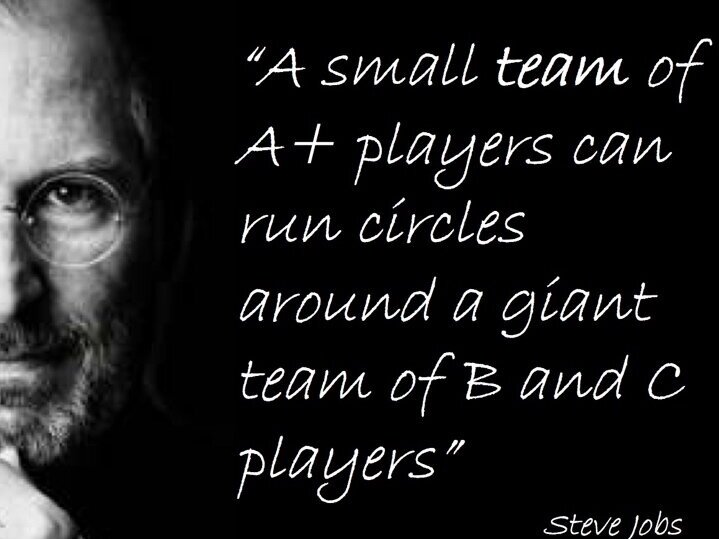
Steve Jobs understood the power of High-Performance Teams and you can too. Organizations like Kraft Foods, General Electric, Hewlett Packard, Newcrest Mining, Exelon, and the US government are increasingly turning their attention to HPTs.
Building an HPT is a straightforward process achievable by any reasonably experienced manager. I know, I have done it many times and with outstanding results. It’s not hard to do.
"I couldn’t wait to get to work each day; we did fantastic things, couldn’t believe I got paid to do it.” A High-Performance team member.
Overview
Why use High-Performance Teams?
To better manage the top management issues of 1. customer satisfaction, 2. the need to do more with fewer resources and 3. a need to have a fast start-up/reaction time to previously unknown business needs and 4. budget constraints.
High-performance teams execute more quickly, make better decisions, solve more complex problems, greatly increase productivity and improve staff morale.
They thrive on change and excel at everything they do. The capability and productivity gap between ordinary teams and high-performance teams are enormous.
They use conflict as a way to invoke innovation, they mentor others on new behaviours and techniques and build new skill sets faster and do more with less.
They can make your life considerably easier and much more enjoyable.
What’s in it for you?
Significantly increased job satisfaction.
More expansive career opportunities.
Working with loyal, supportive, trustworthy people who over time become increasingly better at whatever is being done.
Becoming an employer of choice.
A life experience.
Why aren’t High-Performance Teams common?
They probably exist as only 1:50 teams.
They produced poor outcomes in the 1980/90s- a tot has changed since then.
The mythology around them that they are too hard - nonsense.
Managers are not trained in High-Performance methods, on top of the fact that many managers are not trained at all.
Teams Modus Operandi.
In everything they do, teams need to be focussed and driven by a vision, common goal or organisational aspirations.
Current team structures have lost this focus, they are silo driven, obsessed with project-based delivery, suffer from poorly integrated processes and are unable to rapidly respond to changing business technologies and the need to be more competitive.
High-Performance teams are driven by people and inter-team process, they maximise their complementary skill sets, learn new skillsets, make better decisions, innovate and are objectively more focused in the way they work.
As a manager ‘you’ need.
Personal/career aspirations.
A team vision, common goal or organizational aspirations.
A High-Performance management style, behaviours and techniques.
You and your team need an HPT Management Style, characterised by:
Overlapping management styles.
Mutual accountability.
Mutual commitment and trust.
Conflict as a source of innovation.
Process-driven.
Shared Leadership.
Decision-Making Process.
Management team meeting protocols.
Team Member Mentoring.
Managers Toolkit.
You also need to adopt new Team Behaviours.
Defining what being professional means and then acting professionally.
Developing team rules.
Agreeing on team behaviours.
Clearly defining roles and responsibilities for everyone.
Then you can select from commonly used Techniques.
Building trust.
Earning respect.
Supporting and motivating others.
Body language and persuasion.
Charisma.
Emotional Intelligence.
Time management skills.
Open communication.
Managing conflict.
Using the 80/20 principle.
Having a go.
Smart email.
Timeboxing.
The half-pager.
Problem-solving.
Creation and innovation.
Assisting others with work.
Continuous Learning.
You can either keep managing the way you are or look for a new approach. Successful management regimes of the past helped create today’s organizations that now defy traditional approaches to management. These organizations have flatter organization charts; intricate matrixed reporting lines, many horizontal interdependencies; and employees who know their jobs, goals and competitors better than they did decades ago. In a market in which change is speeding up, the incentive for business to review its approach to management has never been greater. High-Performance Teams are a proven solution to today’s and tomorrows management challenges.